Most UK students only realise there’s a difference between a dissertation and a thesis when a supervisor casually says something like:
“Sampling Strategies for Dissertation Research”
I’ve seen this confusion again and again, undergraduates worrying they’re “not academic enough, Master’s students unsure whether they’re even doing the right type of research, and PhD candidates quietly wondering why everyone keeps using different words for what feels like the same monster-sized project.
So let’s slow this right down.
This guide is written for UK undergraduate, Master’s, MSc, MBA, and PhD students who want a clear, jargon-free explanation of what a dissertation is, what a thesis is, and why the difference actually matters for your grade, structure, and supervisor expectations.
Why UK Students Get Confused (And It’s Not Your Fault)?
Here’s the truth: most universities don’t explain clearly.
- In the UK, the words dissertation and thesis are used differently from those in the US
- Some departments use the terms inconsistently
- International students hear conflicting advice online
- Even supervisors sometimes assume you already know
So if you’ve ever thought,
“Am I supposed to be writing a dissertation or a thesis or both?”
You’re not behind. You’re normal.
The Short Answer (UK Context)
Before we go deeper, here’s the simple UK rule most universities follow:
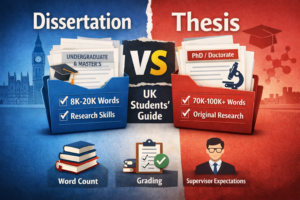
- Undergraduate & Master’s students usually write a dissertation
- PhD students write a thesis
That’s it.
But the why behind that difference is what really helps you write better and score higher.
What Is a Dissertation in the UK?
In the UK academic system, a dissertation is:
A structured, independent research project completed as part of an undergraduate or taught postgraduate degree.
You’ll Usually Write a Dissertation If You’re Studying:
- BA / BSc
- MA / MSc
- MBA
- Professional Master’s degrees
Typical UK Dissertation Features
- Word count
- Undergraduate: ~8,000-10,000 words
- Master’s: ~12,000-20,000 words
- Purpose
- Show you understand research methods
- Apply theory to a focused topic
- Demonstrate critical thinking (not originality)
- Supervision
- One supervisor
- Limited contact time
- Clear marking criteria
- Assessment focus
- Research design
- Literature review quality
- Methodology justification
- Analysis (not a groundbreaking discovery)
Most UK students struggle not because dissertations are impossible, but because expectations are rarely explained in plain English.
What Is a Thesis in the UK?
A thesis in the UK is something very different.
A thesis is an original, in-depth research contribution completed as part of a PhD or doctoral programme.
You’ll Write a Thesis If You’re Studying:
- PhD
- Doctorate (DPhil, DBA, EdD)
Typical UK Thesis Features
- Word count
- 70,000 – 100,000+ words
- Purpose
- Create new knowledge
- Make an original contribution to your field
- Withstand expert examination
- Supervision
- Multiple supervisors
- Ongoing research guidance over the years
- Progress reviews and viva preparation
- Assessment focus
- Originality
- Depth of argument
- Research rigour
- Defence in a viva voce exam
This is why supervisors take thesis-level writing so seriously. It’s not just longer, it’s fundamentally different.
Dissertation vs Thesis: Side-by-Side (UK Perspective)
| Feature | Dissertation (UK) | Thesis (UK) |
| Degree level | Undergraduate / Master’s | PhD / Doctorate |
| Purpose | Demonstrate research ability | Create original knowledge |
| Word count | 8,000–20,000 | 70,000-100,000+ |
| Research originality | Limited | Essential |
| Supervision | Minimal | Extensive |
| Final defence | No | Yes (viva) |
| Stress level | High (but manageable) | Extremely high (long-term) |
If you’re a Master’s student trying to write like a PhD candidate, that’s where marks quietly disappear.
A Common UK Student Scenario (Very Real)
Imagine this:
A Master’s student submits a dissertation packed with complex theory, dense language, and ambitious claims.
The feedback says:
“Overly ambitious for this level. Limited focus. Insufficient depth in analysis.”
What went wrong?
They wrote thesis-style ambition instead of a dissertation-style argument.
UK markers don’t reward complexity for its own sake. They reward clarity, justification, and relevance to the level.
UK Grading Expectations: Why Level Matters
UK universities assess work differently depending on whether it’s a dissertation or a thesis.
Typical UK Marking Bands
- 40% – Pass
- 50-59% – Lower second / Merit (borderline)
- 60-69% – Merit / Strong pass
- 70%+ – Distinction
Many students hover around 58-62% because:
- Their structure doesn’t match the level
- Their methodology is unclear
- Their argument is either too basic or too ambitious
Understanding whether you’re writing a dissertation or a thesis helps you aim at the right academic target.
Myths UK Students Often Believe (But Shouldn’t)
“A dissertation has to be original research”
Not fully. You’re showing research competence, not inventing a new theory.
“More references = higher marks”
Markers care more about how you use sources than how many you list.
“My supervisor didn’t correct it, so it must be fine”
Supervisors guide, they don’t edit or proofread.
“Everyone else understands this better than me”
They don’t. They’re just quieter about it.
When Students Usually Ask for Help (And Why)?
Most UK students reach out for dissertation support when:
- Feedback is vague or confusing
- The literature review feels overwhelming
- Methodology doesn’t “sound academic enough”
- They’re stuck between a pass and a distinction
- Time pressure hits hard (very common)
None of that means you’ve failed. It means you’re at the point where guidance actually helps.
If You’re Feeling Stuck Right Now
If you’re unsure whether your work is too simple, too complex, or just not quite right, you’re not alone.
Many UK students seek guidance at exactly this stage not to “cheat”, but to understand:
- What markers actually expect
- How to improve structure and clarity
- How to move from a pass to a merit or distinction
Getting experienced academic support can save weeks of stress and prevent costly resubmissions.
Final Advice (From Someone Who’s Seen Hundreds of Dissertations)
Your dissertation or thesis isn’t a test of intelligence.
It’s a test of alignment, with your level, your brief, and UK academic expectations.
Once that clicks, everything becomes calmer. More focused. More manageable.
And if you need support figuring that out, reaching out isn’t a weakness.
It’s a strategy.
You don’t have to do this alone.
FAQs: Dissertation vs Thesis (UK Students)
Is a thesis harder than a dissertation?
Yes, but it’s also supported differently. A PhD thesis is challenging because it requires originality and defence.
Do UK Master’s students ever write a thesis?
Rarely. Most write dissertations, even if some departments casually use the word “thesis”.
Can I fail a dissertation?
Yes, but most failures are due to structure, clarity, or misunderstanding expectations, not intelligence.
Does referencing style differ?
No. Harvard, APA, or other styles depend on the department, not the dissertation vs thesis.
Can I get ethical approval help?
Yes. Many students struggle with ethics forms; it’s one of the most common pain points.